The origin of the french word Lice or Lisse (string) is dubious. The etymology seems to reduce the first word from the Latin term licium: wire put transversely; the expression haute lisse (high lisse) was used in nautical for the sailing vessel and meant high aerofoil: The veils and the chechmates of the ships were retained by shrouds (haubans - bonds of top -1138 -), ropes; To maneuvrer the sailors went up on the highest horizontal structure of the vessel which one called the high Lisse (as of bulwark lisses or gunwale lisse). One can suppose that the association of the two definitions could adapt to the mechanical movement which one must apply to the warp of a tapestry. The "lisses" are indeed a kind of wire placed of through and which draw wire from warp, by the top for the vertical loom (Goblin) and downwards for the horizontal loom (Beauvais or Aubusson).
appears for the first time on March 10 year 1302; that in an addition to the ordinances regulating the trade of Paris. These additions establish that a discord had occurred between the sarrazinois (Sarazine tapestry manufacturers) and another kind of manufacturers of tapestries which one called the workmen
à la besche or
nostrez (ours) tapestry in this edict.
The first ones claiming that those could not and did not have the right to work in the city of Paris until they had do the serment, like themselves, to hold and keep all the ordinances of the guild of the manufacturers of Sarazines tapestries, since as much the two trades was similar.
They also complained that the workmen of
haute lisse, not being organized, escaped from the payment of taxes, so that the interests of the King suffered from that, and also interests of much
other good people, because the Masters of high-warp worked during the night and let fear consequences in the work which was
neither good nor sufficient.
In response to this complaint, the Masters of high-warp were ordered to join the guild of the manufacturers of Sarazines tapestries.

Ten
of those (with the approval of an eleventh) and six of these appeared and agree in the share of their respective trade to adhere to all the edict provisions. It moreover was expected that the Masters of high-warp could take apprentices for one eight years period, but not less, and on the payment of 100 money Pennies of Paris,
or smaller sum. The ordinance also ruled that they could not work on their loom of high-warp as much only as they could see by daylight without the assistance of a candle. In order to enforce respect of these ordinances were named: a Master pertaining to the guild of the manufacturers of Sarazines tapestries, or tapestry
à la merche (treadle), and another Master of high-warp, or tapestry
à la beshe (broche).
The manufacturers of
tapestries nostrez named in the ordinances compiled about 1250 per Etienne Boileau, Mayor of Paris, in its book of the
Trades, coarse fabrics and other twills or shuttle are weaver of plain and paterned fabrics to cover floors, walls and furniture. The manufacturers of tapestries sarazines are manufacturers on loom
with treadle, as it is distinctly stated in the addition with the ordinances quoted and summarized above.
Besche is the old French word which corresponds to the word broche. By deduction, therefore, the expression
tapisserie à la beshe (tapestry with the broche) which is stated there is synonymous with tapestry of high-warp and this point, in connection with the chronology of the introduction of these two techniques, can be also regarded as very interesting and significant.
While the most obvious difference between high-warp and low-warp depends on the vertical position of the warp of the first compared with the horizontal position of the warp of the latter, the true one and fundamental difference depends on the fact that low-warp has treadles and the high-warp does not have any, and, also, that the reel of high-warp (which is called broche -spindle- with the Goblins) is of acute form, pointed, whereas the reel, (or flute as one calls it in Beauvais), of low-warp is blunted and is not employed like tool.
A careful reading of the ordinances and addition, establishes that the manufacturers of high-warp were the new ones coming in Paris, perhaps of French Flanders, or at least men who practised a kind of weaving then new in Paris.
Certainly if the expression
tapisserie à la merche used in the addition of the ordinances (found only in the manuscript of the National Library, man. Fr. 24069, fol. 241, and not in the manuscript of the public records, KK 1336, fol. 145 V°) to describe the work of the sarrazinois, is a part of the original document or was added by somebody who knew some about this subject, then, the sarrazinois could not be weaver of carpet of the eastern fashion, since for this kind of carpet, the warp is vertical and the loom without treadles. It is interesting to also note that while the training period of the guild of Sarrazinois was eight years, that of the guild of
nostrez Tapestries was only of four; also that the two guilds were limited to the use of the wool yarn except that
ostrez (the others) could employ any material in manufacture, and thus, whereas nostrez could use the full thread, Sarrazinois could employ the twisted threads (made with several strands).
Aubusson's Tapestry, basic tapestry of low-warp, thus a more economic technique in its execution, would have been established in XVIth century in this area by makers coming from Arras. Its denomination was until the XIXth century
Arrazo Tapestry (from the town, in Flanders, named Arras), or,
tapisserie à la mesche (Tapestry with treadle) because the weaver to operate the warp uses not only its hands over but also its feet on a kind of treadle located below the loom. This idea will be taken up in the Jacquard power loom. Indeed in the recording of its first patent in 1801 he writes:
the essential movement that the workman communicates alternatively with the foot with each treadle, is the main engine.


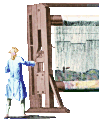



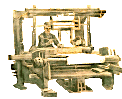 tapestries carried out on vertical loom said high warp (haute lisse), used already by Egyptian as we can see on the picture (left hand side) found in grave of Beni-Hassan (1700-2000 B.C), this was probably too the Homeric loom and also the Scandinavian loom; or horizontal loom said low warp (basse lisse) -Lisse or Lice: hence the name of licier which one gives to those which weave these tapestries.
